Published: July 7, 2026 · By CHILION Engineering Team
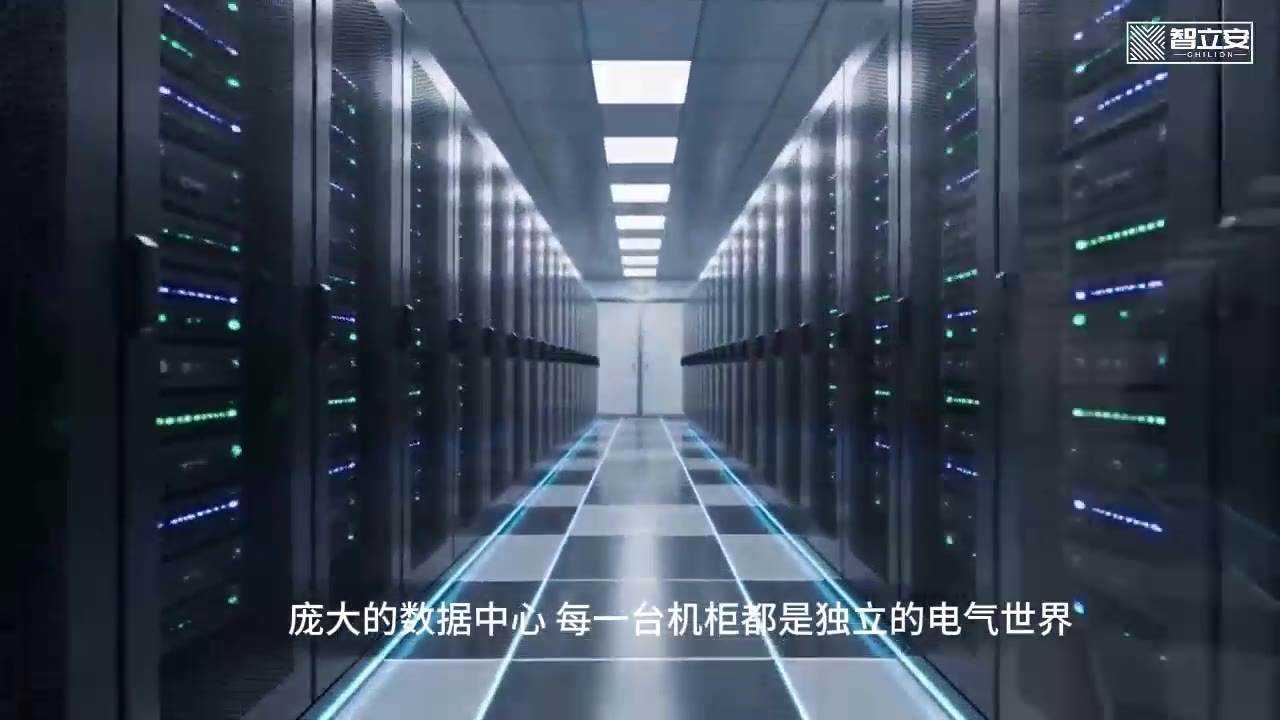
Data center power distribution cabinets operate continuously under high load 24/7. Cable aging, loose connections, and overheating power modules — these hazards lurk deep inside cabinets and are difficult to detect in real time through traditional inspection methods. When a fire breaks out, servers are extremely valuable and data is irreplaceable; even a response time of minutes is far too long.
Guangzhou CHILION Technology Development Co., Ltd. has deployed its self-developed EAPD Electrical Active Protection Device in data center scenarios, verifying its active fire suppression capability in data room environments.
Three Typical Hazards in Data Center Power Distribution Cabinets
Cable aging. Data center power distribution cabinets provide uninterrupted 24/7 power supply. Cable insulation gradually becomes brittle under prolonged high-temperature conditions, with a typical effective service life of approximately 8 years. Cables exceeding their design lifespan may cause tracking or short circuits due to degraded insulation performance.
Loose connections. Electrical connectors in long-term operation develop micro-loosening due to thermal expansion and contraction, leading to increased contact resistance and localized heating. This is one of the common causes of electrical fires in data centers and is difficult to detect visually during inspections.
Overheating power modules. When core power supply units such as UPS and rectifier modules have poor heat dissipation, their housing temperatures rise rapidly. If they continuously exceed the normal operating temperature range, internal component aging may accelerate and even trigger a fire.
What these three hazards have in common is: there are no obvious external signs in the early stages, and once they develop into open flames, the temperature rises extremely fast within seconds — traditional fire protection methods often fail to respond immediately.
EAPD's Full-Loop Closed Cycle: Monitoring — Analysis — Suppression
The design philosophy of EAPD is: complete all actions from hazard monitoring to active fire suppression independently inside the cabinet, without relying on a central control system or external power supply.
Layer 1: Multi-sensor Fusion
The device integrates multiple sensors, covering temperature, humidity, smoke, CO, H₂S, combustible gas, infrared flame, point temperature measurement, passive temperature measurement, active temperature measurement, fiber optic temperature measurement, screw loosening detection, and infrared temperature measurement, paired with AI analysis algorithms for cross-validation of signals. Multiple types of sensing information complement each other, effectively reducing the false alarm rate of any single sensor.
Layer 2: AI Intelligent Analysis
On-board algorithms perform real-time fusion analysis on multi-channel sensing data, distinguishing between abnormal temperature rises and normal operating condition fluctuations. When an abnormal temperature trend is identified, the device enters an early warning state; after comprehensive analysis confirms a fire, the suppression action is triggered in milliseconds.
Layer 3: FLOURGUARD Agent Release
The agent storage chamber inside the device stores FLOURGUARD (FK-5-1-12 perfluorohexanone) clean fire extinguishing agent. After the AI analysis issues a suppression command, the agent storage chamber completes release in milliseconds, extinguishing the incipient fire source.
Under CHILION internal test conditions, the shortest response time from sensor trigger to completion of suppression discharge is 3.9 seconds. Actual response time may vary depending on ambient temperature, remaining agent volume, device deployment location, and other factors.
Deployment Solution
In data center projects, EAPD devices can be deployed one-to-one per cabinet, or a group of devices can cover 2–3 adjacent cabinets. Installation is flexible, supporting magnetic mounting, snap-fit, rail mounting, and adhesive backing — similar to the installation logic of camera devices, without damaging the original cabinet structure.
After deployment, the device can operate independently or be connected to the ICOP Intelligent Comprehensive Operation Platform for remote status monitoring and alarm linkage, allowing operation and maintenance personnel to view environmental parameter changes inside each cabinet from the backend.
Applicable Scenarios
- Data center server cabinets
- Power distribution cabinets / row-head cabinets
- UPS power cabinets
- Precision air conditioning power distribution units
- Communication base station integrated cabinets
Data Center Cabinets: An Instrumentation Strategy
Data centers house their protective devices at the row level rather than at the room level, and the instrumentation strategy that follows from this architecture is different. Each row of cabinets carries its own risk profile and its own reporting line. CHILION structures the instrumentation program to reflect this row-level granularity: each row has its own risk score, its own alert thresholds, and its own maintenance cadence. The operations team reads the row-level state directly, without having to drill past room-level aggregations to find the row that needs attention. The integration with the DCIM platform follows the same logic. The discipline is to instrument at the level that matches the operations team's decision-making cadence, and at the data center the cadence is set by the row.
Spare-Capacity Management and Lifecycle Documentation
Data center cabinets are typically managed against an internal lifecycle, with a defined useful life for the cabinet and a planned refresh cycle. CHILION's deployment is documented in a way that supports that lifecycle. The instrumentation is specified to fit within the cabinet's planned refresh windows, so that the protective gear is replaced in lockstep with the cabinet rather than persisting past its useful life. The spare-cabinet policy is structured around the same logic. The outcome is a documentation set that the data center's asset team can adopt into their lifecycle records with minimal friction, and an operations experience in which protective-device refresh cycles are coincident with cabinet refresh cycles rather than an independent clock.
Data Center Cabinets: An Instrumentation Strategy
Data centers house their protective devices at the row level rather than at the room level, and the instrumentation strategy that follows from this architecture is different. Each row of cabinets carries its own risk profile and its own reporting line. CHILION structures the instrumentation program to reflect this row-level granularity: each row has its own risk score, its own alert thresholds, and its own maintenance cadence. The operations team reads the row-level state directly, without having to drill past room-level aggregations to find the row that needs attention. The integration with the DCIM platform follows the same logic. The discipline is to instrument at the level that matches the operations team's decision-making cadence, and at the data center the cadence is set by the row.
Spare-Capacity Management and Lifecycle Documentation
Data center cabinets are typically managed against an internal lifecycle, with a defined useful life for the cabinet and a planned refresh cycle. CHILION's deployment is documented in a way that supports that lifecycle. The instrumentation is specified to fit within the cabinet's planned refresh windows, so that the protective gear is replaced in lockstep with the cabinet rather than persisting past its useful life. The spare-cabinet policy is structured around the same logic. The outcome is a documentation set that the data center's asset team can adopt into their lifecycle records with minimal friction, and an operations experience in which protective-device refresh cycles are coincident with cabinet refresh cycles rather than an independent clock.
Frequently Asked Questions
Is the instrumentation at row level or room level?
How is the deployment documented for lifecycle management?
The deployment documentation is structured to fit the data center's lifecycle records, with refresh windows aligned to cabinet refresh cycles.
Does the solution integrate with DCIM?
Yes, integration pathways with the major DCIM platforms are documented and supported.
What is the spare-cabinet policy?
The spare-cabinet policy follows the customer's existing lifecycle policy and is documented as part of the deployment record.
Frequently Asked Questions
Is the instrumentation at row level or room level?
How is the deployment documented for lifecycle management?
The deployment documentation is structured to fit the data center's lifecycle records, with refresh windows aligned to cabinet refresh cycles.
Does the solution integrate with DCIM?
Yes, integration pathways with the major DCIM platforms are documented and supported.
What is the spare-cabinet policy?
The spare-cabinet policy follows the customer's existing lifecycle policy and is documented as part of the deployment record.
FAQ
Get detailed technical specs and a tailored solution for the EAPD Electrical Active Protection Device
Contact CHILIONHotline: 400-8558-313