Published: July 13, 2026 · By CHILION Engineering Team
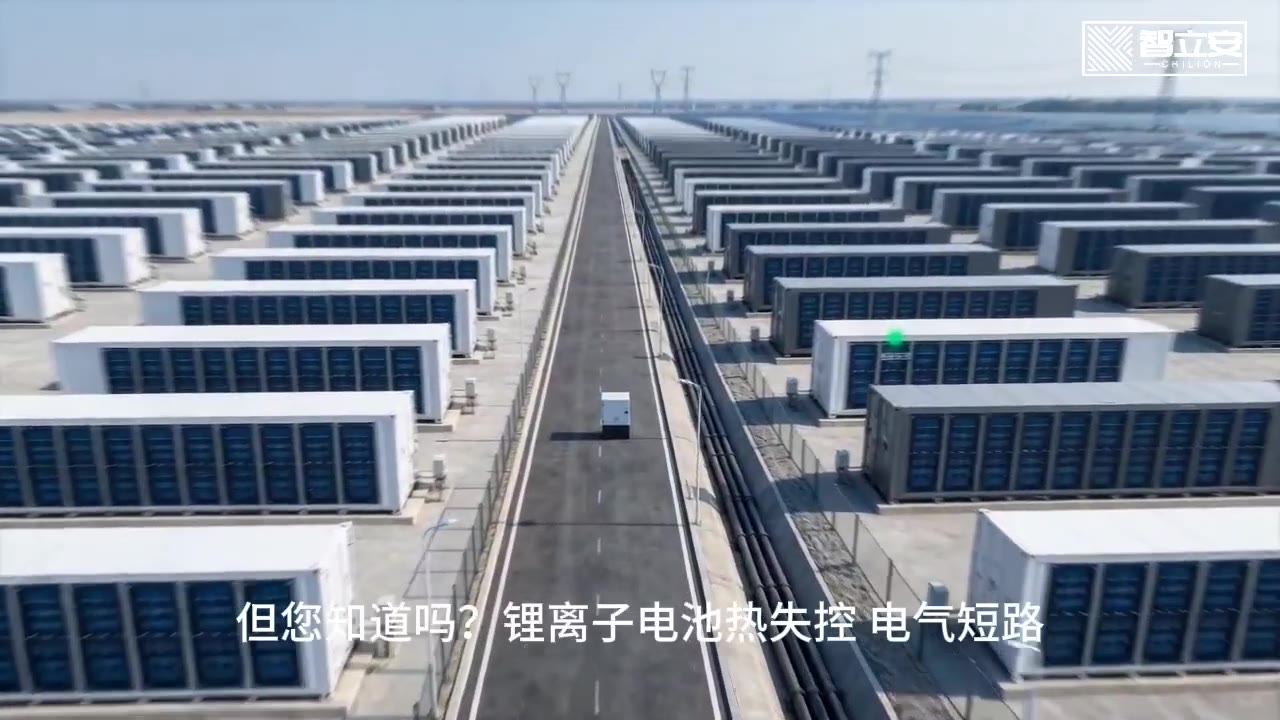
The industry is well aware of the severity of energy storage fires, yet truly implemented protection solutions remain scarce.
EAPD is installed inside battery racks for real-time monitoring and on-site fire suppression, while the ICOP platform manages the entire facility from the cloud.
When a single battery module goes into thermal runaway, its temperature can surge to several hundred degrees Celsius within minutes. Adjacent modules heat up and enter thermal runaway in turn, triggering a chain reaction that can burn through an entire energy storage container.
Traditional solutions rely on either cabinet-type gas suppression or water sprinklers. But by the time gas suppression reaches the battery module, the fire has already spread; water sprinklers, on the other hand, can make lithium battery fires even more intense.
CHILION's solution for energy storage scenarios is clear: EAPD is installed inside battery racks for real-time monitoring and on-site fire suppression, while the ICOP platform handles remote O&M from the cloud.
Three Stages of Thermal Runaway — When Does EAPD Intervene?
Stage 1: Internal short circuit. The separator fails, causing a short between the anode and cathode, and local temperature rises. No external abnormalities are visible, yet the temperature quietly exceeds 100°C.
Stage 2: Pressure relief and venting. The safety valve opens and electrolyte vapor is released. At this point, the temperature reaches 140–200°C — EAPD's multi-channel sensors already detect the anomaly in this stage, and the on-board AI confirms and triggers instant release of the extinguishing agent.
Stage 3: Fire ignition and spread. The electrolyte ignites, and open flames spread to adjacent modules. With EAPD intervention, the fire is suppressed in Stage 2 before it reaches this point.
The time window is very narrow, but EAPD does not require external confirmation — deployed inside the battery rack with sensors directly exposed to the heat source, the entire process from detection to suppression is completed locally.
How EAPD+ICOP Is Deployed at Energy Storage Stations
One EAPD unit per battery rack. It is mounted above or on the side of battery modules using magnetic or adhesive fixation. It works right after installation without altering the module structure or thermal design.
What EAPD handles locally: real-time data collection from multi-channel sensors including temperature, smoke, and combustible gas; on-board AI performs cross-validation to eliminate false alarms from individual sensors; once an anomaly is confirmed, the built-in FluorShield extinguishing agent is released in milliseconds — with zero ODP, non-conductive, non-corrosive, and harmless to batteries and circuit boards.
The entire station connects to the ICOP platform. No matter how many containers or hundreds of battery racks a station has, the ICOP platform displays everything on a single topology map.
O&M personnel no longer need to visit the site every day — by opening the ICOP web portal or mobile App, the status of every battery rack is clear at a glance. Which group shows elevated temperature trends, which EAPD unit has triggered an alarm — all are recorded.
Alerts are pushed by tier. General temperature anomalies are pushed to routine O&M staff. When a fire is confirmed, alerts are pushed to the safety director, station manager, and the owner.
Why the EAPD+ICOP Combined Solution?
Purely passive fire suppression solutions only activate when temperature thresholds are reached — they suppress but do not report. In energy storage scenarios, where stations are scattered in remote areas with low O&M frequency, alarm capabilities and remote management are equally important.
EAPD+ICOP provides a complete closed loop: EAPD handles the full on-site process of detection–assessment–suppression, while ICOP keeps O&M personnel remotely informed of what happened.
After EAPD is triggered, the ICOP platform immediately pushes an alert and records the complete event timeline. O&M personnel know exactly which container and which rack has the issue, and can replace the core module directly on site without troubleshooting.
Applicable Scenarios
- Energy storage battery containers / battery racks
- New energy commercial vehicle battery boxes
- Base station backup battery cabinets
- Residential energy storage devices
- UPS battery rooms
Wherever there are battery modules, EAPD+ICOP has a role to play.
Battery-String vs Conversion-Cabinet Protective Strategies
Energy storage deployments involve two distinct protective realities: the battery string and the conversion cabinet. They behave differently under fault conditions, and a single protective framework that treats both uniformly produces poor outcomes in practice. CHILION's protective program recognizes that distinction. Battery-side instrumentation is configured for signatures that anticipate thermal runaway; conversion-side instrumentation is configured for signatures that anticipate power-electronic failure. The two streams feed a unified dashboard but are evaluated as separate protective contexts, which produces a more accurate protective response than a unified framework would. Field deployments that respect this distinction report better diagnostic accuracy and more targeted protective interventions.
Phased Commissioning Aligned with Capacity Build
Energy storage sites typically build capacity in phases aligned with project finance milestones. The protective deployment must accommodate that phasing. CHILION's commissioning plan treats each phase as a distinct commissioning window, with a uniform configuration applied across the whole site once all phases are complete. The intermediate state, when only some cabinets are commissioned, is treated as a planned configuration rather than as a deployment error. The documentation records the phase boundaries clearly. Operators who maintain a partly commissioned site report that the phased approach produces a coherent protective state without the overhead of repeated reconfiguration.
Battery-String vs Conversion-Cabinet Protective Strategies
Energy storage deployments involve two distinct protective realities: the battery string and the conversion cabinet. They behave differently under fault conditions, and a single protective framework that treats both uniformly produces poor outcomes in practice. CHILION's protective program recognizes that distinction. Battery-side instrumentation is configured for signatures that anticipate thermal runaway; conversion-side instrumentation is configured for signatures that anticipate power-electronic failure. The two streams feed a unified dashboard but are evaluated as separate protective contexts, which produces a more accurate protective response than a unified framework would. Field deployments that respect this distinction report better diagnostic accuracy and more targeted protective interventions.
Phased Commissioning Aligned with Capacity Build
Energy storage sites typically build capacity in phases aligned with project finance milestones. The protective deployment must accommodate that phasing. CHILION's commissioning plan treats each phase as a distinct commissioning window, with a uniform configuration applied across the whole site once all phases are complete. The intermediate state, when only some cabinets are commissioned, is treated as a planned configuration rather than as a deployment error. The documentation records the phase boundaries clearly. Operators who maintain a partly commissioned site report that the phased approach produces a coherent protective state without the overhead of repeated reconfiguration.
Frequently Asked Questions
How does the protective program treat battery-side and conversion-side separately?
Can the deployment accommodate phased capacity build?
Yes, each phase is commissioned independently, with a uniform configuration applied across the whole site once all phases are complete.
What is the typical commissioning duration per phase?
Commissioning durations depend on phase size. The methodology is designed to keep each phase's window short while preserving documentation quality.
Does the documentation capture phase boundaries?
Yes, the phase boundaries are recorded clearly in the deployment documentation so that partly-commissioned states are unambiguous.
Frequently Asked Questions
How does the protective program treat battery-side and conversion-side separately?
Can the deployment accommodate phased capacity build?
Yes, each phase is commissioned independently, with a uniform configuration applied across the whole site once all phases are complete.
What is the typical commissioning duration per phase?
Commissioning durations depend on phase size. The methodology is designed to keep each phase's window short while preserving documentation quality.
Does the documentation capture phase boundaries?
Yes, the phase boundaries are recorded clearly in the deployment documentation so that partly-commissioned states are unambiguous.
FAQ
Need a deployment plan for EAPD Electrical Active Protection Device + ICOP Platform in energy storage systems?
Contact CHILIONService Hotline: 400-8558-313