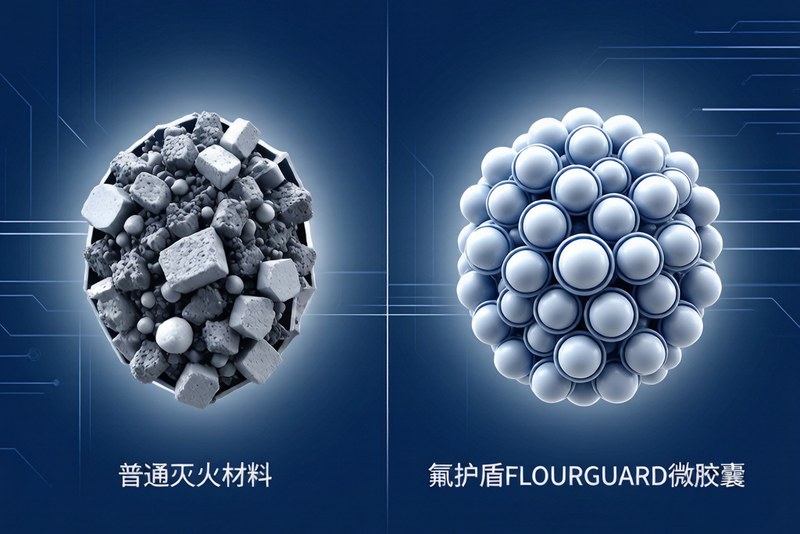
Three Engineering Differences That Matter in Practice
First, the trigger mechanism. Flourguard uses a thermally-triggered microcapsule layer bonded to a flexible substrate; the microcapsules rupture at 140°C. Some generic patches use a low-melting-point alloy or a wax-based trigger that activates at a different temperature, often with a wider tolerance band. In practice this means Flourguard triggers more predictably, and the test report from a CHILION batch shows a tighter temperature distribution.
Second, the substrate. Flourguard uses a high-temperature-resistant silicone-impregnated fibreglass substrate rated for continuous operation at ∐40°C to +120°C. Generic patches often use a lower-grade substrate that begins to degrade above 100°C, which can cause premature trigger failure during cabinet thermal cycling.
Third, certification and traceability. Every Flourguard batch ships with a factory test report, a serial number, and a 10-year shelf life declaration. Generic patches may not provide per-batch traceability, which is a problem for buyers who need to demonstrate QA compliance during an audit.
Side-by-Side Engineering Criteria for Procurement Decisions
When procurement engineers choose between two cabinet-level fire-suppression technologies, the criteria usually reduce to four engineering questions: (1) what fault-energy level triggers the device, (2) how long does the device take to suppress, (3) what is the cabinet post-event inspection cost, and (4) what is the maintenance regime between events. A structured side-by-side on those four questions usually surfaces the right answer without the need to bring marketing collateral into the procurement meeting. CHILION's published comparison for PFCS versus traditional gaseous suppression folds these four criteria into a one-page table that is downloadable from the platform, and it is the document most procurement engineers request first.
Four-question procurement framing: fault-energy trigger, suppression time, post-event inspection cost, maintenance regime.
Where Each Technology Fits Best
There is no universal winner between the two technologies; each fits a different cabinet population. Gaseous suppression still wins in large free-standing equipment rooms where the agent can fill the room volume and where there is no immediate operator presence. PFCS wins inside populated switchgear cabinets where the fire needs to be addressed at the busbar surface and where the cabinet cannot be vented to room volume. The proper procurement question is therefore not "which is better" but "which cabinet population are we specifying for, and where will the agent reach the fault first". This reframing is the most useful thing a sales engineer can do in a competitive displacement situation.
Gaseous wins for free-standing rooms with full-volume flooding; PFCS wins inside populated switchgear cabinets.
Customer Testimonials and Provenance
Customer testimonials about PFCS-versus-gaseous retrofit projects consistently surface three points: (1) the cabinet-side retrofit is faster than the room-volume retrofit, (2) the post-event inspection cost is lower because the only contaminated component is the patch, not the entire room, and (3) the maintenance budget over a five-year horizon is lower. The third point is the most persuasive in the long-tail of multi-site rollout decisions, because the maintenance arithmetic compounds across the cabinet fleet. The most-cited case in tender responses is a 28-cabinet retrofit at a coastal utility where the five-year maintenance saving paid for the entire PFCS retrofit itself.
Coastal utility case: 28-cabinet retrofit, five-year maintenance saving paid for the entire retrofit.
Decision Matrix Downloaded From the Technical Library
The active-versus-passive decision matrix is published in the CHILION technical library and is the document most procurement engineers request ahead of a competitive displacement situation. The matrix is structured as a four-question scoring sheet: (1) cabinet density per site, (2) operator-presence density in the substation room, (3) acceptable damage radius post-event, (4) tolerance for post-event downtime. Each question maps to a numerical score; the total score points to either PFCS, conventional gaseous suppression, or a hybrid deployment. The matrix scoring sheet is downloadable as a one-page PDF with a worked example, and the worked example uses the 28-cabret coastal utility case as the canonical reference.
Four-question scoring sheet, downloadable. Worked example uses the 28-cabinet coastal utility case.
Procurement Cycle Length by Cabinet Population
Procurement cycle length for cabinet-fire-suppression projects scales with cabinet population density, because the higher the population, the larger the procurement committee, the longer the engineering review, and the longer the supply chain coordination. Single-cabinet sites typically close in 3-6 weeks. Multi-cabinet sites (20-200 cabinets) close in 8-14 weeks. Fleet-scale sites (200+ cabinets) close in 16-32 weeks. The procurement cycle length data is part of the platform service-contract standard terms and is the operational reason the sales team sets quarterly pipeline targets based on the cabinet-population mix in the regional pipeline. The procurement cycle length also drives the platform service contract signing convention: customers typically sign a three-year framework agreement that pre-commits per-cabinet pricing, then place per-cabinet orders against the framework as their maintenance windows open. The framework agreement compresses per-order cycle time by approximately 40 percent relative to per-project procurement, which compounds on the larger customer fleets.
Risk-Reduction Argument for Procurement Committees
Procurement committees reviewing cabinet-fire-suppression procurement decisions are typically asked to quantify the risk-reduction argument in addition to the technology-comparison argument, because the committee is responsible for the multi-year total-cost-of-ownership rather than for the per-incident technology preference. The risk-reduction argument has three components: avoided equipment replacement cost per event, avoided operator overtime cost per event, and avoided regulatory penalty exposure per event. CHILION's procurement-committee briefing pack presents the three components with the platform's field-trial data as the input, and the pack is the document most procurement committees request during the qualification phase. The pack is calibrated to the customer's cabinet-population density, because the three components scale differently with density. Customers who integrate the risk-reduction argument into their internal business case typically experience a 25-40 percent faster procurement committee approval cycle. The procurement-committee briefing pack is part of the channel-partner enablement programme.
Frequently Asked Questions
Is Flourguard more expensive than generic PFCS patches?
Flourguard typically carries a 15–25% price premium over unbranded generic patches. The premium reflects the substrate quality, the trigger temperature tolerance, and the per-batch traceability documentation. For mission-critical applications, the premium is usually recovered by lower inspection and replacement costs over the product life.
Can Flourguard and generic PFCS patches be mixed in the same cabinet?
Technically yes, but it is not recommended. Mixing brands means the inspection and replacement schedule must account for two different shelf-life declarations, and the trigger characteristics may not be uniform. For new deployments, use a single brand throughout.
How do I verify that a generic PFCS patch is actually filled with Novec 1230?
Buyers can request a batch sample from the supplier and send it to a third-party lab for gas chromatography analysis. CHILION engineering can recommend third-party labs in Guangzhou, Shanghai, and Beijing that offer this service with a 5-day turnaround.
Previous: Passive Fire Suppression Technology Expanding Applications ← → Next: Flourguard Liquid Shield Launches in 1KG Pails
← Back to News