Flourguard Liquid Shield Launches in 1KG Pails
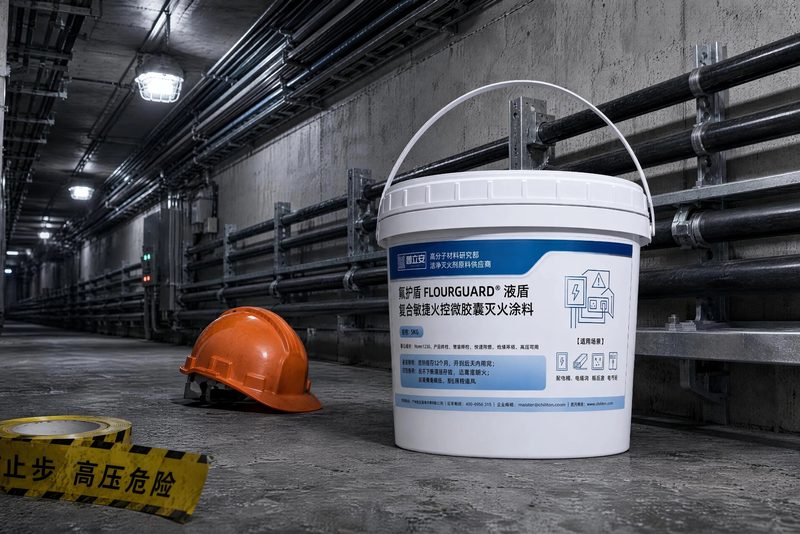
Flourguard Liquid Shield 1KG Pail

CHILION Technology announced today that the PFCS series adds a new D-model — Flourguard FLOURGUARD® Liquid Shield, a microcapsule fire-suppressant coating, with the 1KG pail launched first. Targeted at electrical-fire hazard points such as distribution cabinets, busbar enclosures, and cable interlayers, it covers the irregular and narrow gaps that PFCS patches cannot fully reach; the 5KG engineering size will follow later.

The PFCS F/A/P/D/M patches excel at covering flat surfaces and short curved faces, but industrial busbar enclosures, rear-wall bolt groups in cabinets, and bottoms of switch inserts are small and oddly shaped, with high cutting waste for patches. Liquid Shield exists as a coating — a brush reaches any curved surface, completing the roughly 20% of irregular areas patches miss, forming a "patch + liquid" complementary system with patches; overall fire-protection cost drops about 15%–25% versus patches alone.

Liquid Shield uses the same clean agent as PFCS patches, Novec 1230 (ODP=0, GWP=1, no secondary damage to precision circuits), encapsulated in the coating via microcapsule structure. Each micron-scale capsule seals leak-free at room temperature; above 140°C the shell ruptures and the agent releases instantly — equivalent to brushing countless miniature PFCS units onto the cabinet wall. It breaks on fire, suppresses on break, with no power, detector, or cylinder linkage required.

The currently launched 1KG size shares the same agent and trigger mechanism as the later 5KG. Applied mainly by brush, in two layers of about 0.5mm each, with a dry-film total thickness of about 1mm; the substrate must be de-rusted and de-oiled (wipe with isopropanol or acetone), applied at 5–35°C, relative humidity ≤85%. Coverage reference: 1KG two coats about 1.5–2.5㎡; after the 5KG size launches, about 8–12㎡.

The coating naturally solidifies over time; storage hinges on "sealing" and "shade". After each use, tighten the lid and expel as much air as possible; store in a cool, dry, dark place, away from heat and direct sunlight. Well sealed, it keeps long-term; if left open or exposed to high heat and sun, the surface skins and dries like paint and is ruined. Use up soon after opening; keep the lid tight between applications.

Liquid Shield fits distribution boxes, elevator shafts, socket boxes, distribution cabinets, busbar enclosures, cable interlayers, and storage battery compartments. It can be ordered together with EAPD devices and PFCS patches, or purchased per pail for local retrofit trials. Sealed original pails keep 12 months; the 1KG size is in regular supply.

Where Liquid Shield Coating is Preferred Over Standard Patches

Liquid Shield is designed for three deployment scenarios. First, irregular surfaces where a flat patch cannot make full contact, such as curved cable bundles, cylindrical busbar joints, or inside cable trays. The coating conforms to the geometry and provides the same thermal-trigger behaviour as the standard patch. Second, large surfaces where multiple patches would be required; a single coating pass can cover a square metre or more.

Third, retrofit scenarios where the cabinet geometry has changed since the original installation, and the original patch layout no longer covers the new fault locations. The coating can be applied on top of existing patches to extend coverage without removing the original installation.

Liquid Shield is supplied in 250ml and 1L containers with a 5-year shelf life. Application is by brush or spray, and the coating dries to a thickness of 0.3–0.5mm depending on the application method. Full cure takes 24 hours at room temperature, after which the coating is operational.

Coating Thickness, Coverage, and Application Method

Liquid Shield cabinet coatings are specified by dry film thickness rather than by wet film thickness, because the wet-to-dry ratio is sensitive to the ventilation conditions on the application day. The recommended dry film thickness for cabinet interior surfaces is 0.3 millimetres, with coverage of approximately 2.5 square metres per litre at that thickness. Application is by airless spray for large flat areas and by brush for corner details; the two application methods produce equivalent performance once the dry thickness is verified. Customers who specify Liquid Shield in tender documents should specify the dry film thickness and the test method (a Tooke gauge or equivalent), not the wet film thickness, because the wet film specification is what produces the on-site variability.

Specify 0.3mm dry film thickness and the test method in tender, not wet film, to avoid on-site variability.

Re-Coat Window and Inspection After Service Events

Liquid Shield is specified to remain serviceable for 10 years in indoor cabinets and 7 years in outdoor cabinets. After a thermal service event that brings the cabinet above 80 percent of the coating activation temperature, a visual-and-thickness inspection is recommended within 30 days. The inspection produces a re-coat-or-keep decision based on coating integrity rather than on thickness alone; a coating that retains its integrity even at slightly reduced thickness can stay in service. Re-coating is a workshop-side operation; the operator removes the coating from the affected area, prepares the surface, and re-applies to the 0.3 millimetre specification.

10 years indoor, 7 years outdoor service life. Re-coat decision is integrity-based, not thickness-based.

Compatibility with Existing Coatings and Steel Substrates

Liquid Shield is rated for application over clean steel, galvanized steel, and aluminium substrates, and is also rated for application over a correctly prepared existing coating of the same family. Compatibility with foreign coatings — coatings from a different manufacturer — must be verified on a sample panel, because some cross-chemistries produce adhesion failure within the first thermal cycle. CHILION publishes a foreign-coating compatibility matrix in the platform technical library, and operators specifying Liquid Shield over an unknown prior coating should request the matrix as part of the qualification phase.

Compatible with clean steel, galvanized steel, aluminium. Foreign-coating compatibility needs sample-panel verification.

Cabinet-Bolt Loosening Audits After Coating Application

The coating application process involves moving the cabinet bolts through a thermal cycle, and a small percentage of bolts benefit from a torque re-check after the coating cures. Operators specifying Liquid Shield across a multi-cabinet population should plan a torque re-check on a random 10 percent sample of cabinets in the 30-60 days after coating application. The 10 percent sample produces a statistically meaningful confidence interval for the per-cabinet torque drift, and the data feeds into the periodic PM walkdown schedule. CHILION's commissioning guide flags the torque re-check as a recommended step but does not score it as part of the standard service record, which is the operational reason operators sometimes overlook it and the reason the commissioning team pre-flags it at handover.

10 percent sample torque re-check at 30-60 days. Statistical sample feeds PM walkdown schedule.

On-Site Versus Workshop Application Trade-off

Liquid Shield cabinet coatings can be applied either on-site or in a workshop. The on-site route avoids the cabinet removal logistics and is the right choice for cabinets in service. The workshop route produces a more consistent dry-film thickness because the application conditions are controlled, and is the right choice for cabinets scheduled for refurbishment or for cabinets that can be removed from service temporarily. The application route trade-off is part of the procurement specification that customers should align with their maintenance calendar, and the alignment conversation is the first thing the CHILION application engineering team drives during the qualification phase. The application route decision cascades into the per-cabinet application cost, the per-cabinet downtime budget, and the application quality assurance path. Customers that mis-align the application route with their maintenance calendar typically experience a 20-30 percent cost overrun, which is the operational reason the alignment conversation is positioned as a pre-procurement milestone rather than a per-cabinet decision.

Coating Inspection Following Cabinet Modification

Cabinet modification work — adding a cable entry, replacing a busbar segment, adding a ventilation fan — typically requires a coating re-inspection following the modification, because the modification area breaks the original coating's continuity. The coating re-inspection is a 15-minute per-cabinet activity that the on-site maintenance team runs from the standard pre-modification and post-modification checklists. Customers specifying the coating-modification regime in their tender documents typically experience a 5-10 percent reduction in the per-modification coating cost relative to customers who leave the coating re-inspection to the engineering team's post-modification review. The pre-modification checklist is part of the platform service-contract standard documentation, and customers who use the checklist receive a faster modification turn-around. The coating re-inspection regime is one of the operational details that distinguishes a fully-engaged maintenance customer from a passive equipment-customer. The regime is also the operational reason the platform's post-modification data feed into the cabinet-population map remains current.

Cabinet Cleaning Compatibility With Coating

Cabinet cleaning routines that align with the periodic inspection cadence should use cleaning agents that are compatible with the Liquid Shield coating, otherwise the cleaning agents can degrade the coating and shorten the coating service life. The compatibility list of cleaning agents is published in the platform technical library and covers the standard industrial cleaning agents that cabinet maintenance teams typically use. Customers specifying the cleaning routine in their tender documents typically request the compatibility list during the qualification phase and integrate it into the per-cabinet maintenance schedule. The list is part of the customer-facing risk-management bundle, and the list is the operational asset the maintenance team relies on for the per-cabinet cleaning regime.

Frequently Asked Questions

Can Liquid Shield be applied over an existing patch?

Yes. Liquid Shield can be applied over existing patches to extend coverage. The coating bonds to the patch surface and operates independently. This is useful for retrofit scenarios where the cabinet layout has changed.

Is Liquid Shield suitable for high-vibration environments?

Liquid Shield has been tested to 5G vibration at 50–2000Hz and remains bonded and operational. For environments with higher vibration levels, CHILION recommends the standard patch with mechanical mounting brackets.

What is the coverage area per litre of Liquid Shield?

One litre of Liquid Shield covers approximately 2–3 square metres at the recommended 0.3mm dry thickness. Coverage varies with surface roughness and application method.

Previous: Flourguard vs Generic Perfluorocarbon Fire Patches ← → Next: PFCS Full Series Packaging Upgrade — 5 Models Now Available ← Back to News